
Mashed Potatoes – The Science of Creaminess
Publié le 27/05/2026
Extrait du document
«
Mashed Potatoes – The Science of Creaminess
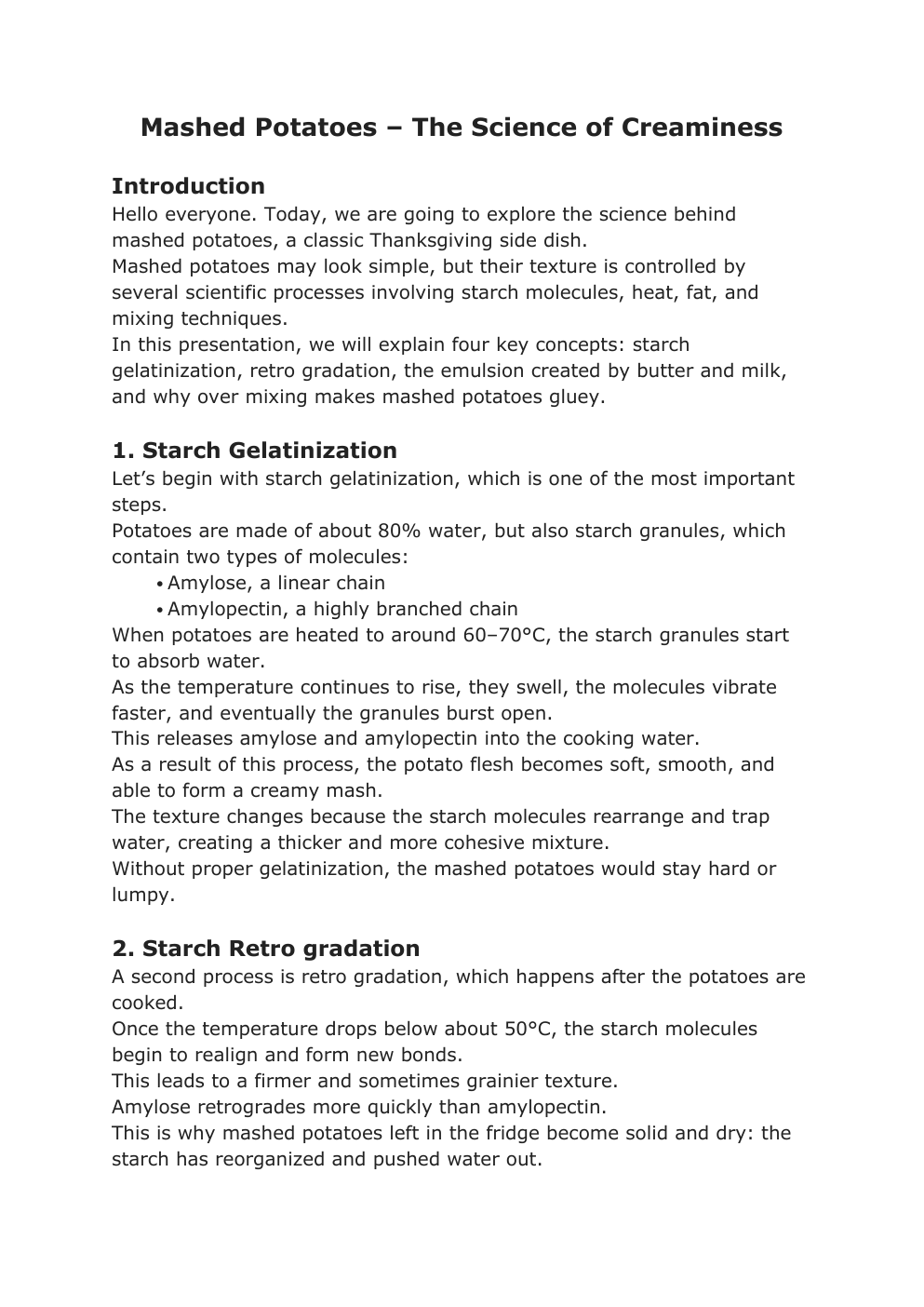
Introduction
Hello everyone.
Today, we are going to explore the science behind
mashed potatoes, a classic Thanksgiving side dish.
Mashed potatoes may look simple, but their texture is controlled by
several scientific processes involving starch molecules, heat, fat, and
mixing techniques.
In this presentation, we will explain four key concepts: starch
gelatinization, retro gradation, the emulsion created by butter and milk,
and why over mixing makes mashed potatoes gluey.
1.
Starch Gelatinization
Let’s begin with starch gelatinization, which is one of the most important
steps.
Potatoes are made of about 80% water, but also starch granules, which
contain two types of molecules:
Amylose, a linear chain
Amylopectin, a highly branched chain
When potatoes are heated to around 60–70°C, the starch granules start
to absorb water.
As the temperature continues to rise, they swell, the molecules vibrate
faster, and eventually the granules burst open.
This releases amylose and amylopectin into the cooking water.
As a result of this process, the potato flesh becomes soft, smooth, and
able to form a creamy mash.
The texture changes because the starch molecules rearrange and trap
water, creating a thicker and more cohesive mixture.
Without proper gelatinization, the mashed potatoes would stay hard or
lumpy.
2.
Starch Retro gradation
A second process is retro gradation, which happens after the potatoes are
cooked.
Once the temperature drops below about 50°C, the starch molecules
begin to realign and form new bonds.
This leads to a firmer and sometimes grainier texture.
Amylose retrogrades more quickly than amylopectin.
This is why mashed potatoes left in the fridge become solid and dry: the
starch has reorganized and pushed water out.
As a result, mashed potatoes taste best when they are served hot, before
retro gradation has time to happen.
3.
The Role of Butter and Milk: An Emulsion
Next, let’s talk about the fats we add.
Butter is composed of fat, water, and milk solids, while milk contains....
»
↓↓↓ APERÇU DU DOCUMENT ↓↓↓

Liens utiles
- « L’idée de Bien est le principe de la science et de la vérité » PLATON
- Quelles sont les conditions d'une science de l'histoire ?
- Grand oral sujet Hlp: comment la science-fiction tente d’anticiper les dérives possibles de nos sociétés actuelles
- Hanif Kureishi - The Buddha of Suburbia
- does the end justifies the means