
Organisation de l'encéphale
Publié le 21/02/2026
Extrait du document
«
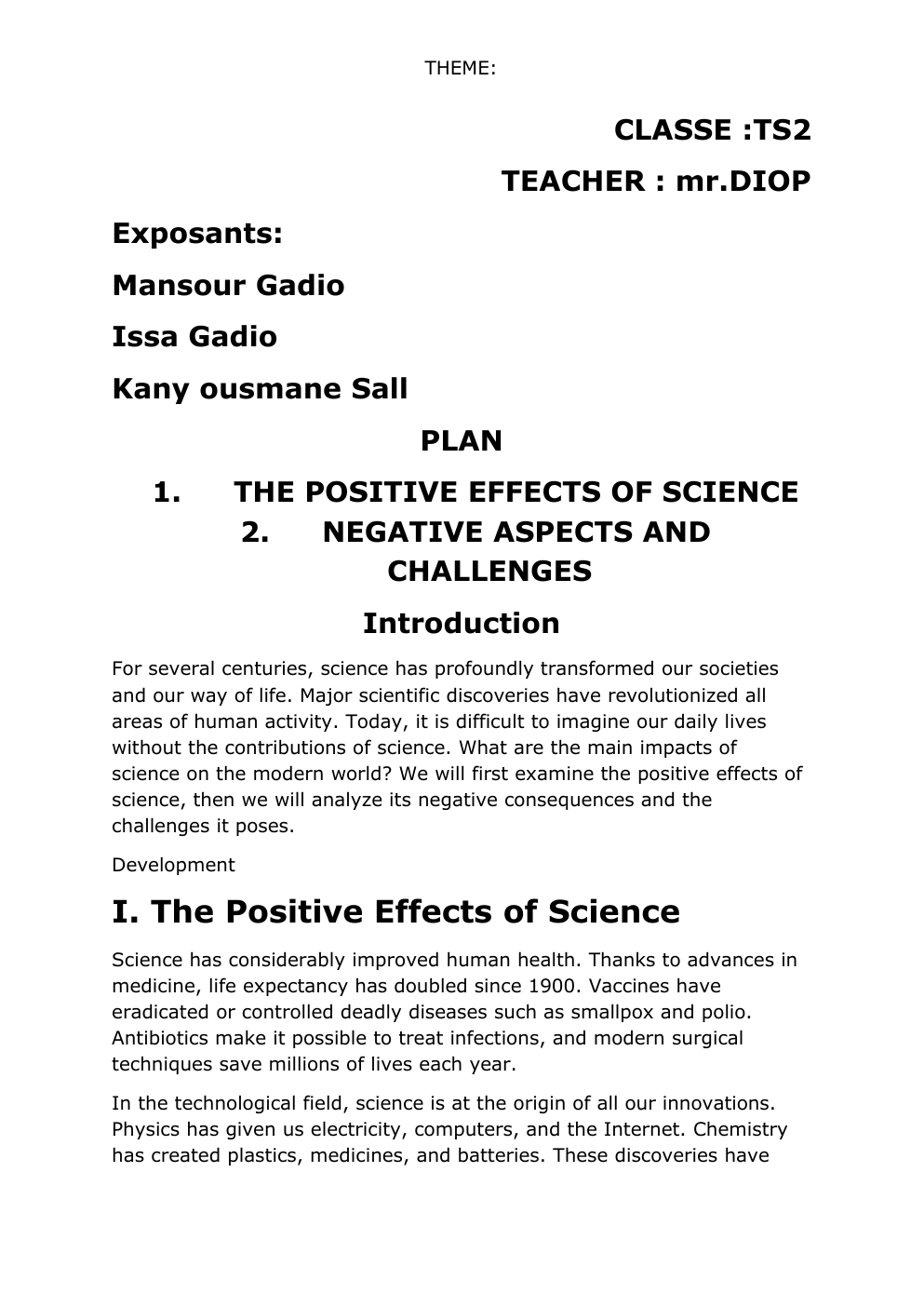
PLAN
1.
THE POSITIVE EFFECTS OF SCIENCE
2.
NEGATIVE ASPECTS AND
CHALLENGES
Introduction
For several centuries, science has profoundly transformed our societies
and our way of life.
Major scientific discoveries have revolutionized all
areas of human activity.
Today, it is difficult to imagine our daily lives
without the contributions of science.
What are the main impacts of
science on the modern world? We will first examine the positive effects of
science, then we will analyze its negative consequences and the
challenges it poses.
Development
I.
The Positive Effects of Science
Science has considerably improved human health.
Thanks to advances in
medicine, life expectancy has doubled since 1900.
Vaccines have
eradicated or controlled deadly diseases such as smallpox and polio.
Antibiotics make it possible to treat infections, and modern surgical
techniques save millions of lives each year.
In the technological field, science is at the origin of all our innovations.
Physics has given us electricity, computers, and the Internet.
Chemistry
has created plastics, medicines, and batteries.
These discoveries have
THEME:
revolutionized how we communicate, work, and access information
instantaneously.
Agriculture has also benefited from scientific advances.
The "Green
Revolution" has multiplied agricultural yields through better seeds,
chemical fertilizers, and improved cultivation techniques.
This has made it
possible to feed a global population that today exceeds 8 billion
inhabitants.
Finally, science has made modern transportation and space exploration
possible.
Cars, planes, and rockets have transformed our relationship with
distance and travel, allowing humanity....
»
↓↓↓ APERÇU DU DOCUMENT ↓↓↓

Liens utiles
- Quels sont les impacts, positifs et négatifs, de l'organisation des Jeux olympiques ?
- COMPÉTENCE, COMITÉS D'ORGANISATION C. E. 31 juill. 1942, MONPEURT, Rec. 239
- Comment les littoraux participent-ils à l’organisation des espaces productifs dans le monde ?
- Organisation fonctionnelle des plantes à fleur
- Guerre froide: Pq le monde se divise en blocs et quelles sont les conséquences de cette nouvelle organisation mondiale ?