
Anglais juridique
Publié le 02/06/2026
Extrait du document
«
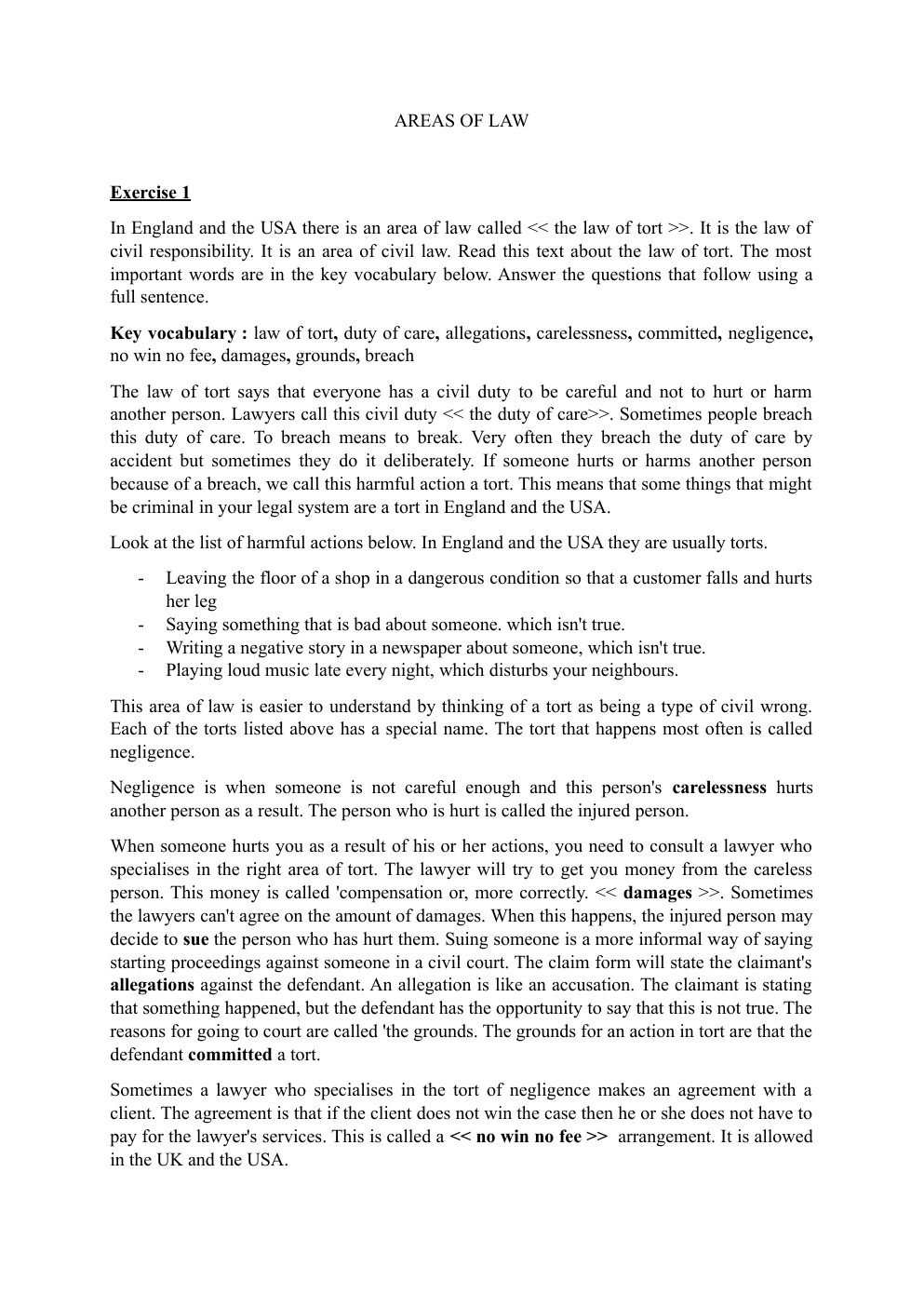
AREAS OF LAW
Exercise 1
In England and the USA there is an area of law called >.
It is the law of
civil responsibility.
It is an area of civil law.
Read this text about the law of tort.
The most
important words are in the key vocabulary below.
Answer the questions that follow using a
full sentence.
Key vocabulary : law of tort, duty of care, allegations, carelessness, committed, negligence,
no win no fee, damages, grounds, breach
The law of tort says that everyone has a civil duty to be careful and not to hurt or harm
another person.
Lawyers call this civil duty >.
Sometimes people breach
this duty of care.
To breach means to break.
Very often they breach the duty of care by
accident but sometimes they do it deliberately.
If someone hurts or harms another person
because of a breach, we call this harmful action a tort.
This means that some things that might
be criminal in your legal system are a tort in England and the USA.
Look at the list of harmful actions below.
In England and the USA they are usually torts.
-
Leaving the floor of a shop in a dangerous condition so that a customer falls and hurts
her leg
Saying something that is bad about someone.
which isn't true.
Writing a negative story in a newspaper about someone, which isn't true.
Playing loud music late every night, which disturbs your neighbours.
This area of law is easier to understand by thinking of a tort as being a type of civil wrong.
Each of the torts listed above has a special name.
The tort that happens most often is called
negligence.
Negligence is when someone is not careful enough and this person's carelessness hurts
another person as a result.
The person who is hurt is called the injured person.
When someone hurts you as a result of his or her actions, you need to consult a lawyer who
specialises in the right area of tort.
The lawyer will try to get you money from the careless
person.
This money is called 'compensation or, more correctly.
>.
Sometimes
the lawyers can't agree on the amount of damages.
When this happens, the injured person may
decide to sue the person who has hurt them.
Suing someone is a more informal way of saying
starting proceedings against someone in a civil court.
The claim form will state the claimant's
allegations against the defendant.
An allegation is like an accusation.
The claimant is stating
that something happened, but the defendant has the opportunity to say that this is not true.
The
reasons for going to court are called 'the grounds.
The grounds for an action in tort are that the
defendant committed a tort.
Sometimes a lawyer who specialises in the tort of negligence makes an agreement with a
client.
The agreement is that if the client does not win the case then he or she does not have to
pay for the lawyer's services.
This is called a > arrangement.
It is allowed
in the UK and the USA.
Example question: What is the duty of care?
Example answer: The duty of care is the obligation to be careful and not to hurt anyone.
A In England and the USA, is the law of tort an area of criminal or civil law?
Answer :
B There are different types of tort.
In general, what is a tort ?
Answer:
C.
What is the name of the tort that a person commits because he or she is careless and hurts
someone else as a result of this carelessness ?
Answer:
D What does suing mean ?
Answer:
E What is the correct name for the money that an injured person gets from the defendant in a
successful action in tort ?
Answer:
What is the correct name for an arrangement where a client does not have to pay his or her
lawyer if the client loses his or her action in tort ?
Answer:
Exercise 2
Put a word from the key vocabulary in Exercise 1 into the following sentences
A l am ……….
the owner of the shop because there was water on the floor and I fell and hurt
my back
B I am a lawyer....
»
↓↓↓ APERÇU DU DOCUMENT ↓↓↓
Liens utiles
- Le statut juridique du fœtus
- Droit: ENVIRONNEMENT JURIDIQUE DE L’ENTREPRISE
- oral dossier llce anglais
- Flou juridique concernant la commercialisation du cannabidiol
- Exemple de Syllogisme juridique