
THEME 1: democracie en danger
Publié le 25/05/2026
Extrait du document
«
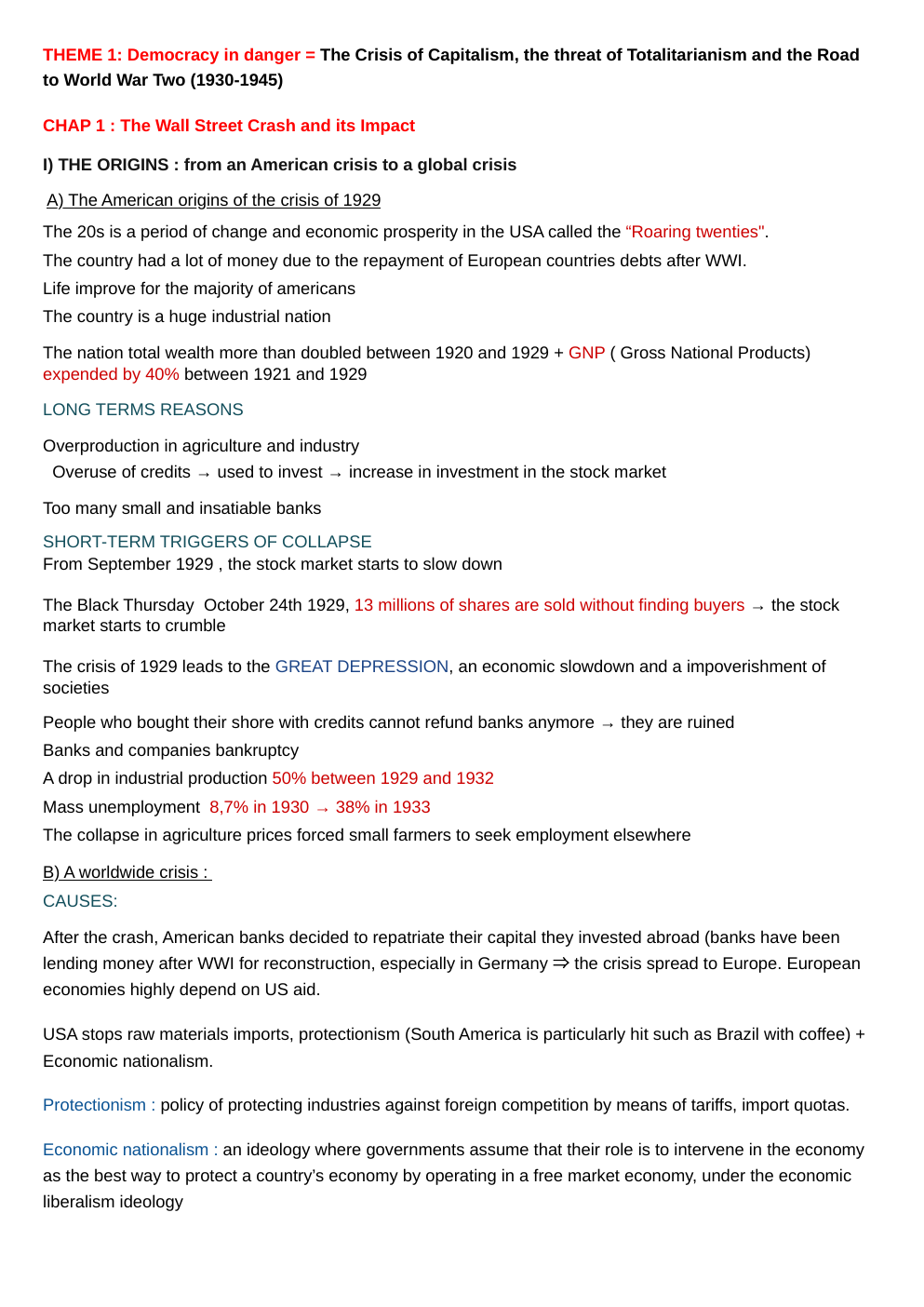
THEME 1: Democracy in danger = The Crisis of Capitalism, the threat of Totalitarianism and the Road
to World War Two (1930-1945)
CHAP 1 : The Wall Street Crash and its Impact
I) THE ORIGINS : from an American crisis to a global crisis
A) The American origins of the crisis of 1929
The 20s is a period of change and economic prosperity in the USA called the “Roaring twenties".
The country had a lot of money due to the repayment of European countries debts after WWI.
Life improve for the majority of americans
The country is a huge industrial nation
The nation total wealth more than doubled between 1920 and 1929 + GNP ( Gross National Products)
expended by 40% between 1921 and 1929
LONG TERMS REASONS
Overproduction in agriculture and industry
Overuse of credits → used to invest → increase in investment in the stock market
Too many small and insatiable banks
SHORT-TERM TRIGGERS OF COLLAPSE
From September 1929 , the stock market starts to slow down
The Black Thursday October 24th 1929, 13 millions of shares are sold without finding buyers → the stock
market starts to crumble
The crisis of 1929 leads to the GREAT DEPRESSION, an economic slowdown and a impoverishment of
societies
People who bought their shore with credits cannot refund banks anymore → they are ruined
Banks and companies bankruptcy
A drop in industrial production 50% between 1929 and 1932
Mass unemployment 8,7% in 1930 → 38% in 1933
The collapse in agriculture prices forced small farmers to seek employment elsewhere
B) A worldwide crisis :
CAUSES:
After the crash, American banks decided to repatriate their capital they invested abroad (banks have been
lending money after WWI for reconstruction, especially in Germany
the crisis spread to Europe.
European
economies highly depend on US aid.
⇒
USA stops raw materials imports, protectionism (South America is particularly hit such as Brazil with coffee) +
Economic nationalism.
Protectionism : policy of protecting industries against foreign competition by means of tariffs, import quotas.
Economic nationalism : an ideology where governments assume that their role is to intervene in the economy
as the best way to protect a country’s economy by operating in a free market economy, under the economic
liberalism ideology
CONSEQUENCES :
- banks went bankrupt (Austria, Germany and Great Britain were bit hard)
- unemployment soared (43% in Germany in 1932), leading to widespread poverty.
- Rise of authoritarian regime as a solution to solve the crisis.
- Social unrest with demonstrations “against hunger and starvation”
⇒ THE ECONOMIC CRISIS DISRUPTS THE POLITICAL AND SOCIAL WORLD BALANCE
II.
How to overcome the crisis?
“Laissez-faire” policy of Hoover, thinking that the market will regulate itself + decrease in imports
(protectionism) , resulting in a tightening of global trade and crisis worsening.
The Smooth-Hawley tariff act passed in 1930 that raised import duties to protect American businesses and
farmers → ineffective due to retaliation from other countries taxing foreign products as well.
Another strategy: devaluation (=lowering the value of your currency) in order to make your export goods more
competitive but other countries did the same, leading to a collapse of the global monetary system.
⇒ BOTH POLICIES FAILED.
ECONOMISTS SUCH AS THE AMERICAN JOHN MAYNARD KEYNES
SUPPORTS MORE STATE INTERVENTION IN THE ECONOMY TO SOLVE THE CRISIS
A) New policies enhance the role of the state in a democracy
USA : Franklin Delano Roosevelt elected president in 1932 = introduces a vast programme to revive the
economy and resolve unemployment in the country :
THE NEW DEAL
A state involved in the economy
– Measures to restore confidence in the banking system
– Industrial reforms
– Agricultural subsidies
A welfare state
– Creation of public sector jobs to reduce unemployment
– Creation of social security for workers
Political modernisation
– A president closer to the people
– The “brain trust” a new group of advisers
⇒ The New Deal inspired other countries, such as France
FRANCE : less touched by the crisis because they depended less on USA’s loans= more affected by the
repercussions of the crisis in Germany and UK → economic depression in the late 30’s but could watch how
the other countries reacted before but don’t have the money for an economic recovery = punctual reforms with
a minister instability
THE FRONT POPULAIRE
“happy strikes”, great depression, threat of far right movements in France with political corruption = the fascist
coup d’Etat attempt of February 6th 1934.
⇒The unification of left-wing parties (socialists, communists and radicals) to counter the fascist threat and win
the future legislative elections.
THE MATIGNON AGREEMENTS
Front Populaire victory in May 1936 caused big strikes with factory occupations in a festive atmosphere to
celebrate the victory, high hope for workers and their working conditions.
In the long term, it was the economic
crisis that had been affecting the country since the early 1930s.
This was a context of social crisis,
characterised by unemployment and poverty.....
»
↓↓↓ APERÇU DU DOCUMENT ↓↓↓

Liens utiles
- en quoi le réchauffement climatique peut être un danger pour notre santé ? SVT
- The danger of space exploration on the human body and the environment
- La prise d’Aspirine est – elle vraiment sans danger ?
- Pourquoi les GAFAM sont-ils un danger pour la démocratie ?
- THEME 3 : Corps humain et santé / La réaction inflammatoire : un exemple de réponse innée