
Review The Count of Monte-Cristo
Publié le 27/04/2026
Extrait du document
«
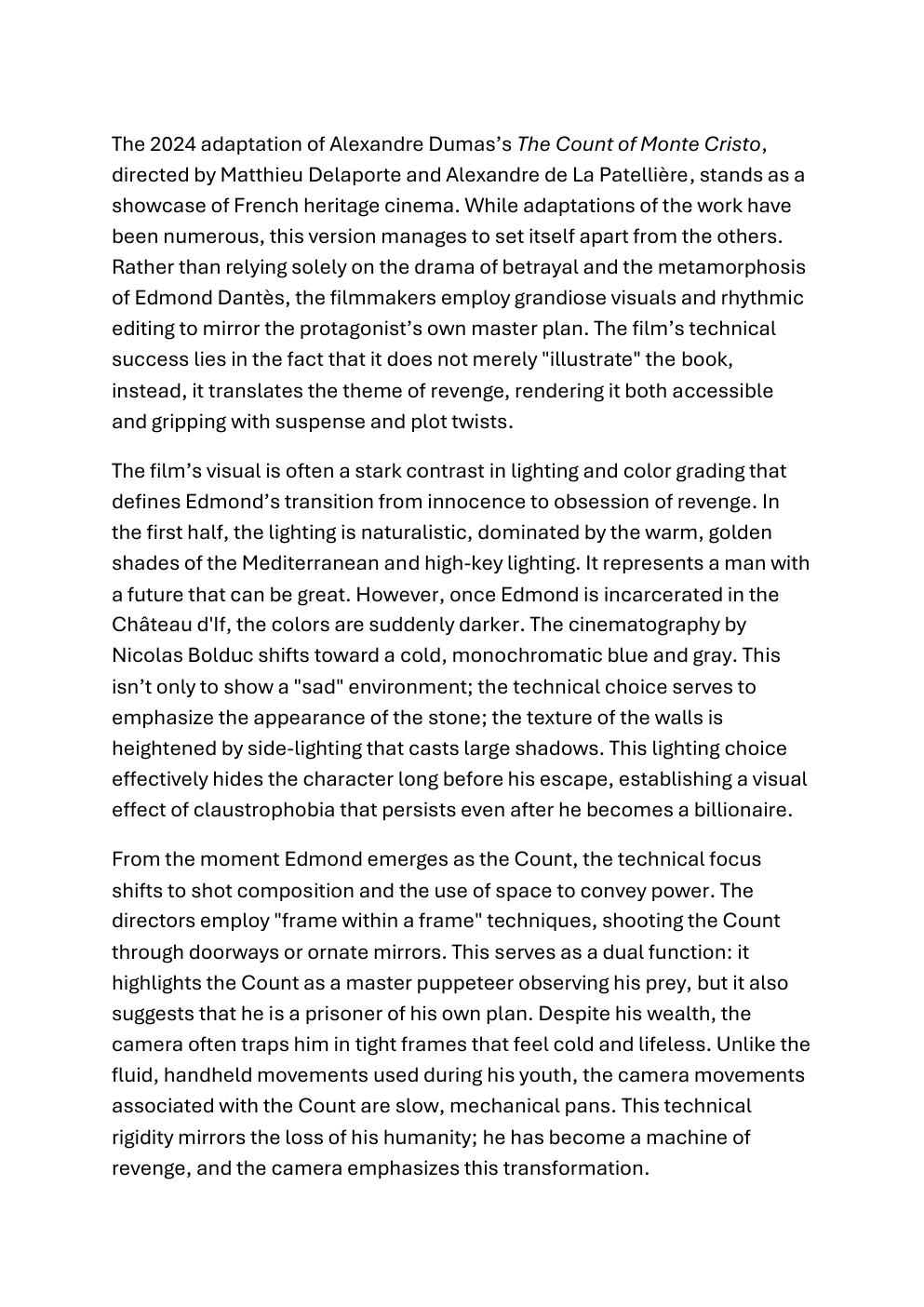
The 2024 adaptation of Alexandre Dumas’s The Count of Monte Cristo,
directed by Matthieu Delaporte and Alexandre de La Patellière, stands as a
showcase of French heritage cinema.
While adaptations of the work have
been numerous, this version manages to set itself apart from the others.
Rather than relying solely on the drama of betrayal and the metamorphosis
of Edmond Dantès, the filmmakers employ grandiose visuals and rhythmic
editing to mirror the protagonist’s own master plan.
The film’s technical
success lies in the fact that it does not merely "illustrate" the book,
instead, it translates the theme of revenge, rendering it both accessible
and gripping with suspense and plot twists.
The film’s visual is often a stark contrast in lighting and color grading that
defines Edmond’s transition from innocence to obsession of revenge.
In
the first half, the lighting is naturalistic, dominated by the warm, golden
shades of the Mediterranean and high-key lighting.
It represents a man with
a future that can be great.
However, once Edmond is incarcerated in the
Château d'If, the colors are suddenly darker.
The cinematography by
Nicolas Bolduc shifts toward a cold, monochromatic blue and gray.
This
isn’t only to show a "sad" environment; the technical choice serves to
emphasize the appearance of the stone; the texture of the walls is
heightened by side-lighting that casts large shadows.
This lighting choice
effectively hides the character long before his escape, establishing a visual
effect of claustrophobia that persists even after he becomes a billionaire.
From the moment Edmond emerges as the Count, the technical focus
shifts to shot composition and the use of space to convey power.
The
directors employ "frame within a frame" techniques, shooting the Count
through doorways or ornate mirrors.
This serves as a dual function: it
highlights the Count as a master puppeteer observing his prey, but it also
suggests that he is a prisoner of his own plan.
Despite his wealth, the
camera often traps him in tight frames that feel cold and lifeless.
Unlike the
fluid, handheld movements used during his youth, the camera movements
associated with the Count are slow, mechanical pans.
This technical
rigidity mirrors the loss of his humanity; he has become a machine of
revenge, and the camera emphasizes this transformation.....
»
↓↓↓ APERÇU DU DOCUMENT ↓↓↓

Liens utiles
- DUMAS, Alexandre Davy de la Pailleterie, dit Alexandre (1802-1870)Ecrivain, il est habile à dresser des personnages inoubliables, entraînés dans des intrigues mouvementées à l'exemple du Comte de Monte-Cristo et des Trois Mousquetaires.
- Hanif Kureishi - The Buddha of Suburbia
- does the end justifies the means
- the handmaid's tale: How far do you agree that Margaret Atwood makes resistance central to THT?
- La surprise au cinéma - Critique The King of Staten Island et Annette