
Portfolio English JALIS and the Israel-Palestine border
Publié le 13/01/2026
Extrait du document
«
JALIS and the Israel-Palestine border
English LV
Sophie JALIS
Date:
1-media critique of Carlos Latuff’s Cartoon on the
Israel–Palestine Border
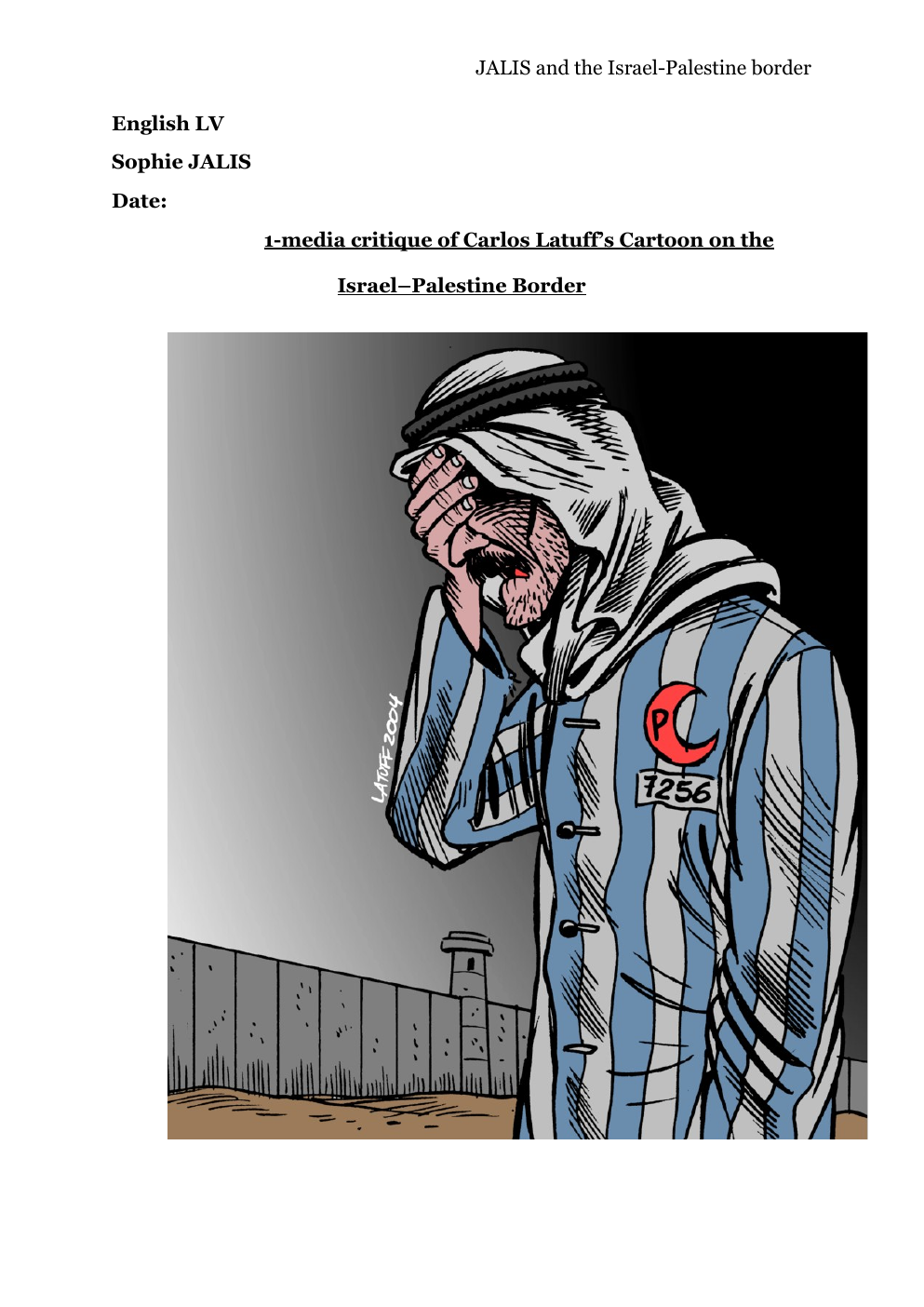
This political cartoon made in 2004 by Carlos Latuff' focus on criticizing the
Israeli-Palestinian conflict, more precisely on the building of the West Bank
barrier.
Latuff who is known worldwide for supporting Palestinian rights,
often show the Israeli government in a negative way while using simple yet
strong visuals to paint the barrier as a symbol of the systematic oppression of a
population.
The cartoon uses many symbols to get its message across about
the current political climate without needing any words so in that way a lot of
people can get emotionally captivated by the drawing.
In the first plan of the picture, we can see that Latuff represented someone in a
blue and white striped uniform.
This outfit immediately remind us of someone
which freedom is being taken, locked up and not being free but if we take a
closer look, it instantly creates a strong and symbolic image.
His stripped
uniform is linked to prisoners and more specifically the uniforms worn during
the holocaust by prisoners especially in nazi concentration camps.
On one
hand, the color blue could suggest coldness and suffering while the white color
suggest emptiness and loss but on the other hand those colors remind us of
the Israeli flag.
By this representation, Carlos Latuff suggest that Palestinians
are being treated as if they were collectively imprisoned, oppressed by a
terrible system while they are losing their freedom and are being
dehumanitated.
Moreover, this idea of the World War II is showed by noticing on the uniform
that there's a patch with a red crescent with the letter P and the number 7256
engrave on it.
The color red of the crescent is usually associated with
danger,violence,blood…highlighting the seriousness of the situation and
identity of Palestinians by their national flag that contains red.
The red crescent is usually linked to the Muslim world or organizations
providing assistance, which puts the person in a context related to the Middle
East with Muslim majority societies that could be represented also with a
headwear.
In many of the author cartoons, this peace of headwear called a
“keffiyeh “held by a black “agal”is meant to represent here Palestinians.
A
keffiyeh is a traditional middle eastern headscarf that symbolize cultural
identity and resistance.
Also, the letter P in the red crescent gives back the
letters “PC” that could have many meanings for example Prisoner of
Conscience or Palestinian Cause, making the person a symbol of the
Palestinian people.
Additionally, the number reinforces the idea of being in prison and turns again
the person into one prisoner out of many suggesting that this situation is
affecting lots of people, not just a few.
Furthermore, we notice that the person
posture: he is covering his face with his hand while looking sad, ashamed and
really tired.
The author instantly makes this person seem more human and
vulnerable making us feel empathy and pity for him.
However, behind him, in the second plan, there's a long wall with a guard
tower on top.
In other words, it’s based on the Israeli West Bank barrier that
was put up during the second “Intifada”.
He uses this artistic interpretation to
present a powerful statement about how oppressive this type of barrier can be
for those affected by it.
Indeed, it doesn't look like a wall meant to keep people
safe but it looks more like it's part of a giant prison.
By using this comparison,
Latuff is saying to us that the barrier isn't profoundly really about protection
but more about controlling, separating and punishing the entire population.
The guard tower makes this clearer since it evokes the idea of being watched
all the time by an authoritarian government.
Over all with these simple things,
the cartoon turns the whole Palestinian area into a kind of prison where
regular people are in fact the inmates.
In addition, Carlos’s message takes life across the strong emotions and
symbols in the picture.
By showing religious symbols, the representation of a
Palestinian civilian as a prisoner with his....
»
↓↓↓ APERÇU DU DOCUMENT ↓↓↓
Liens utiles
- Isaac Newton I INTRODUCTION Isaac Newton (1642-1727), English physicist, mathematician, and natural philosopher, considered one of the most important scientists of all time.
- Essay English : In Arthur Miller's play "All my sons", Joe Keller is a hero in his family and in the neighborhood even if he did some very awful things.
- The danger of space exploration on the human body and the environment
- Article - The power of words - Words, a powerful political and social weapon ?
- After forever, I got out of bed and went to the closet where I kept the phone.