Axiology
Publié le 16/05/2020

Extrait du document
«
Axiology
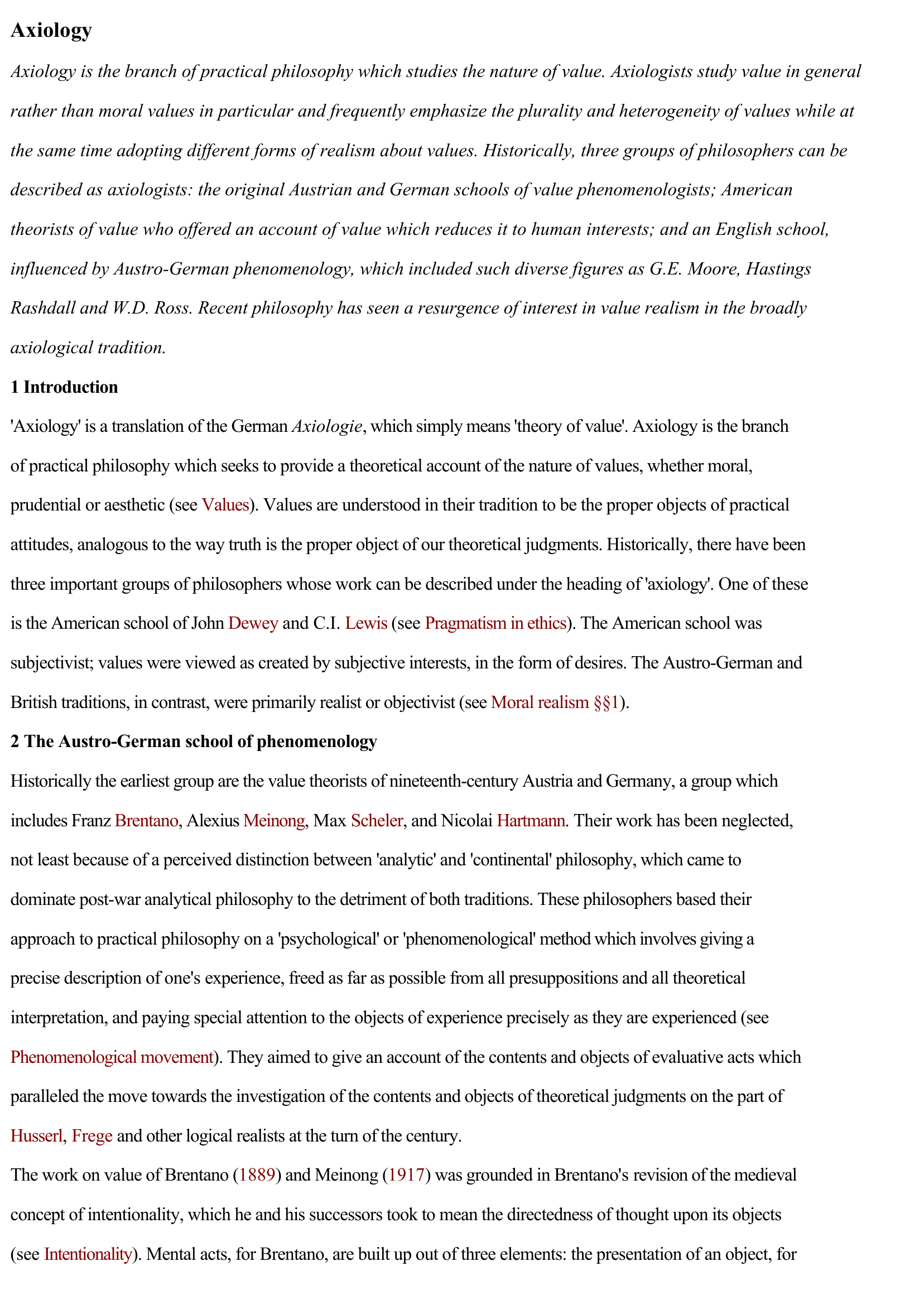
Axiology is the branch of practical philosophy which studies the nature of value.
Axiologists study value in general
rather than moral values in particular and frequently emphasize the plurality and heterogeneity of values while at
the same time adopting different forms of realism about values.
Historically, three groups of philosophers can be
described as axiologists: the original Austrian and German schools of value phenomenologists; American
theorists of value who offered an account of value which reduces it to human interests; and an English school,
influenced by Austro-German phenomenology, which included such diverse figures as G.E.
Moore, Hastings
Rashdall and W.D.
Ross.
Recent philosophy has seen a resurgence of interest in value realism in the broadly
axiological tradition.
1 Introduction
'Axiology' is a translation of the German Axiologie , which simply means 'theory of value' .
Axiology is the branch
of practical philosophy which seeks to provide a theoretical account of the nature of values, whether moral,
prudential or aesthetic (see Values ).
Values are understood in their tradition to be the proper objects of practical
attitudes, analogous to the way truth is the proper object of our theoretical judgments.
Historically, there have been
three important groups of philosophers whose work can be described under the heading of 'axiology' .
One of these
is the American school of John Dewey and C.I.
Lewis (see Pragmatism in ethics ).
The American school was
subjectivist; values were viewed as created by subjective interests, in the form of desires.
The Austro-German and
British traditions, in contrast, were primarily realist or objectivist (see Moral realism §§1 ).
2 The Austro-German school of phenomenology
Historically the earliest group are the value theorists of nineteenth-century Austria and Germany, a group which
includes Franz Brentano , Alexius Meinong , Max Scheler , and Nicolai Hartmann .
Their work has been neglected,
not least because of a perceived distinction between 'analytic' and 'continental' philosophy, which came to
dominate post-war analytical philosophy to the detriment of both traditions.
These philosophers based their
approach to practical philosophy on a 'psychological' or 'phenomenological' method which involves giving a
precise description of one's experience, freed as far as possible from all presuppositions and all theoretical
interpretation, and paying special attention to the objects of experience precisely as they are experienced (see
Phenomenological movement ).
They aimed to give an account of the contents and objects of evaluative acts which
paralleled the move towards the investigation of the contents and objects of theoretical judgments on the part of
Husserl , Frege and other logical realists at the turn of the century.
The work on value of Brentano ( 1889 ) and Meinong ( 1917 ) was grounded in Brentano 's revision of the medieval
concept of intentionality, which he and his successors took to mean the directedness of thought upon its objects
(see Intentionality ).
Mental acts, for Brentano, are built up out of three elements: the presentation of an object, for.
»
↓↓↓ APERÇU DU DOCUMENT ↓↓↓