
I love lucy
Publié le 26/05/2026
Extrait du document
«
AXIS:…………………..………………………………….
Sequence:…………………………………………….
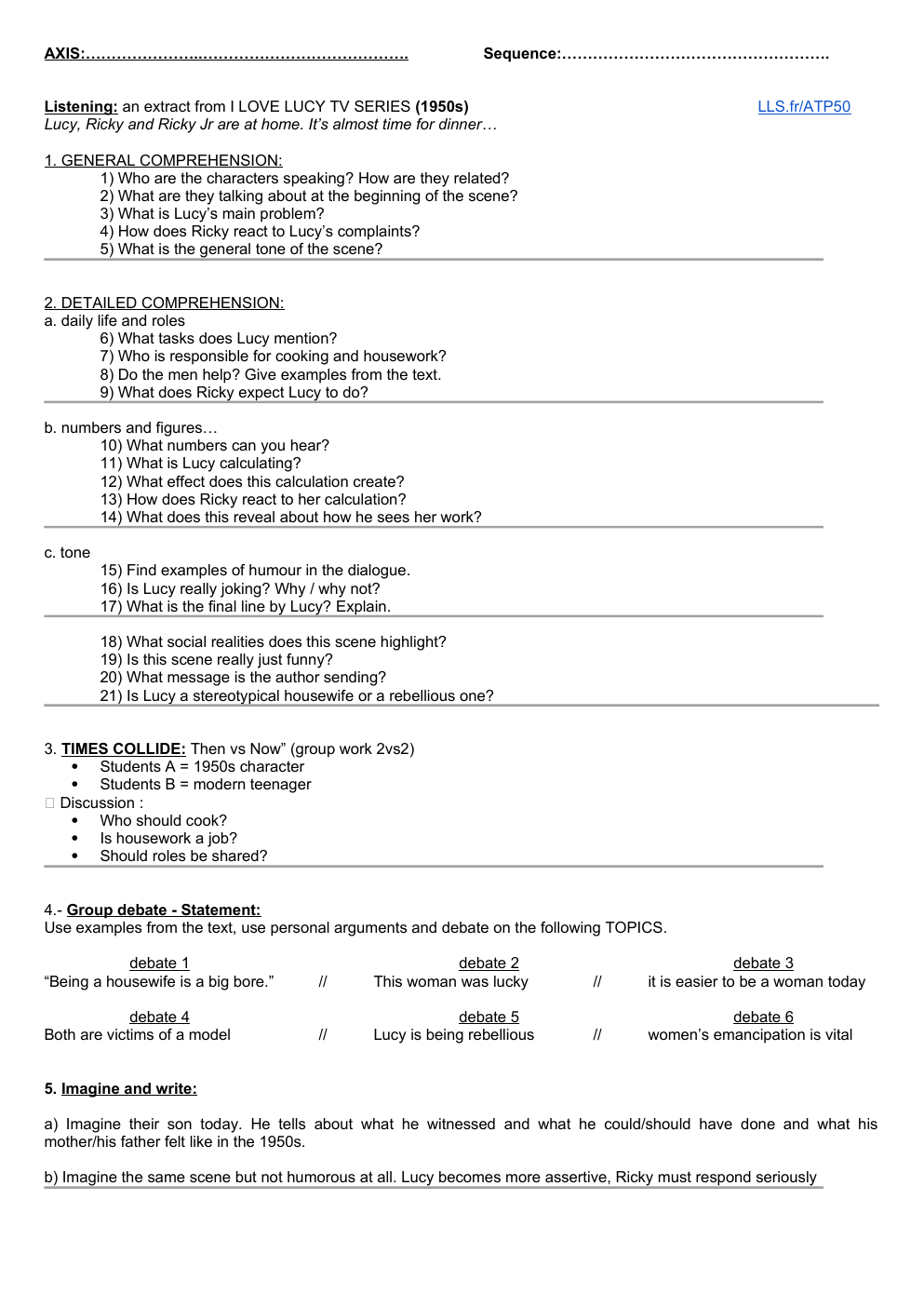
Listening: an extract from I LOVE LUCY TV SERIES (1950s)
Lucy, Ricky and Ricky Jr are at home.
It’s almost time for dinner…
LLS.fr/ATP50
1.
GENERAL COMPREHENSION:
1) Who are the characters speaking? How are they related?
2) What are they talking about at the beginning of the scene?
3) What is Lucy’s main problem?
4) How does Ricky react to Lucy’s complaints?
5) What is the general tone of the scene?
2.
DETAILED COMPREHENSION:
a.
daily life and roles
6) What tasks does Lucy mention?
7) Who is responsible for cooking and housework?
8) Do the men help? Give examples from the text.
9) What does Ricky expect Lucy to do?
b.
numbers and figures…
10) What numbers can you hear?
11) What is Lucy calculating?
12) What effect does this calculation create?
13) How does Ricky react to her calculation?
14) What does this reveal about how he sees her work?
c.
tone
15) Find examples of humour in the dialogue.
16) Is Lucy really joking? Why / why not?
17) What is the final line by Lucy? Explain.
18) What social realities does this scene highlight?
19) Is this scene really just funny?
20) What message is the author sending?
21) Is Lucy a stereotypical housewife or a rebellious one?
3.
TIMES COLLIDE: Then vs Now” (group work 2vs2)
Students A = 1950s character
Students B = modern teenager
👉 Discussion :
Who should cook?
Is housework a job?
Should roles be shared?
4.- Group debate - Statement:
Use examples from the text, use personal arguments and debate on the following TOPICS.
debate 1
“Being a housewife is a big bore.”
//
debate 2
This woman was lucky
//
debate 3
it is easier to be a woman today
debate 4
Both are victims of a model
//
debate 5
Lucy is being rebellious
//
debate 6
women’s emancipation is vital
5.
Imagine and write:
a) Imagine their son today.
He tells about what he witnessed and what he could/should have done and what his
mother/his father felt like in the 1950s.
b) Imagine the same scene but not humorous at all.
Lucy becomes more assertive, Ricky must respond seriously
suite à l'étude de la vidéo I LOVE LUCY, compléter la transcription + lire le cours (questions + REPONSES)
ci-après
🔹 I.
Compréhension globale
Who are the characters speaking? What is their relationship?
→ The characters are Lucy, Ricky and their son Ricky Jr.
Lucy and Ricky are married.
What are they talking about at the beginning of the scene?
→ They are talking about what to have for dinner.
What is Lucy’s main problem?
→ She is tired of always having to plan and cook meals.
How does Ricky react to Lucy’s complaints?
→ He does not take her seriously.
He avoids the problem and tells her to decide.
What is the general tone of the scene?
→ The tone is humorous, but there is also frustration and irony.
🔹 II.
Compréhension détaillée
A.
Daily life and roles
What tasks does Lucy mention?
→ Cooking meals, doing the dishes, making the beds, dusting the house.
Who is responsible for cooking and housework?
→ Lucy is entirely responsible.
Do the men help? Give examples from the text.
→ No, they do not help.
They just give vague answers like “I don’t care” or make suggestions.
What does Ricky expect Lucy to do?
→ He expects her to decide and prepare meals, as usual.
→ Traditional gender roles / woman confined to domestic tasks.
B.
The “19,000 meals” passage
Why does Lucy start calculating the number of meals?
→ To show how much work she has done over the years.
What effect does this calculation create?
→ It exaggerates the situation and makes it both funny and shocking.
How does Ricky react to her calculation?
→ He makes jokes and minimizes it (mentions meals outside, “same sad story”).
What does this reveal about how he sees her work?
→ He does not consider it important or difficult.
→ Invisible labour / lack of recognition.
C.
Tone and irony
Find examples of humour in the dialogue.
→ The exaggerated calculation (19,710 meals), Ricky’s jokes, repetition of chores.
Is Lucy really joking? Why / why not?....
»
↓↓↓ APERÇU DU DOCUMENT ↓↓↓

Liens utiles
- LOVE AIR LINES
- FALLING IN LOVE
- Il investit son avoir sur un coup de tête et, peu après, ses titres montèrent en flèche. D. Y. Béchard, Vandal Love ou Perdus en Amérique, Québec Amérique
- love
- THE MAN I LOVE